
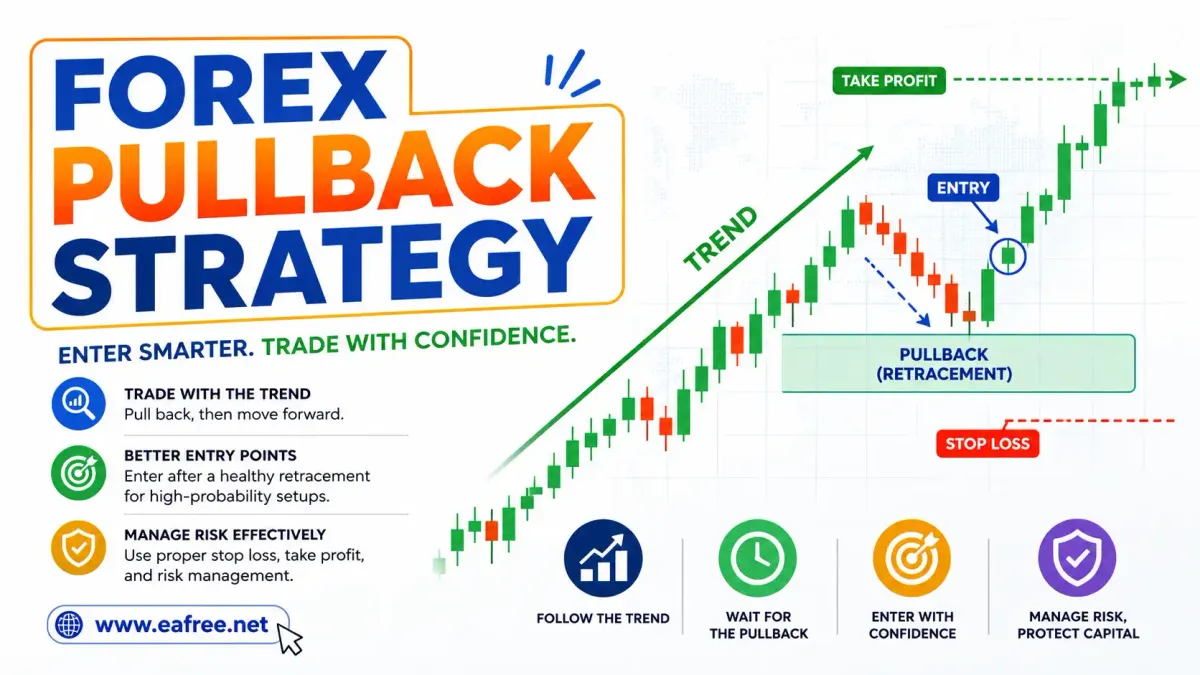
The forex market is known for its fast price movements and endless trading opportunities. However, many beginner traders make the mistake of chasing the market instead of waiting for high-probability setups. This is where the Forex Pullback Strategy becomes extremely effective.
A pullback strategy allows traders to enter the market after a temporary retracement within an existing trend. Instead of buying at the top or selling at the bottom, traders wait for price to “pull back” before entering with better risk-to-reward opportunities.
In this guide, you will learn how the forex pullback strategy works, how to identify strong setups, proper entry and exit techniques and the best ways to manage risk.
What is a Forex Pullback Strategy?
A forex pullback strategy is a trend-following trading method where traders enter after the price temporarily moves against the main trend before continuing in the original direction.
In simple terms:
- In an uptrend, traders wait for price to fall slightly before buying.
- In a downtrend, traders wait for price to rise temporarily before selling.
Pullbacks are normal market behavior because no trend moves in a straight line. Markets naturally retrace before continuing higher or lower.
The goal of this strategy is to avoid emotional entries and improve trade timing.

Why Pullback Trading Works
Pullback trading works because it aligns traders with the dominant market trend while offering better entry prices.
Some major benefits include:
| Benefit | Explanation |
|---|---|
| Better Risk-to-Reward Ratio | Entries occur closer to support or resistance levels |
| Reduced Emotional Trading | Traders wait for confirmation instead of chasing price |
| Higher Probability Setups | Trades follow the overall market direction |
| Clear Stop Loss Placement | Pullback zones provide logical invalidation points |
This strategy is commonly used by professional forex traders because it combines patience, discipline, and trend confirmation.
How to Identify a Valid Pullback
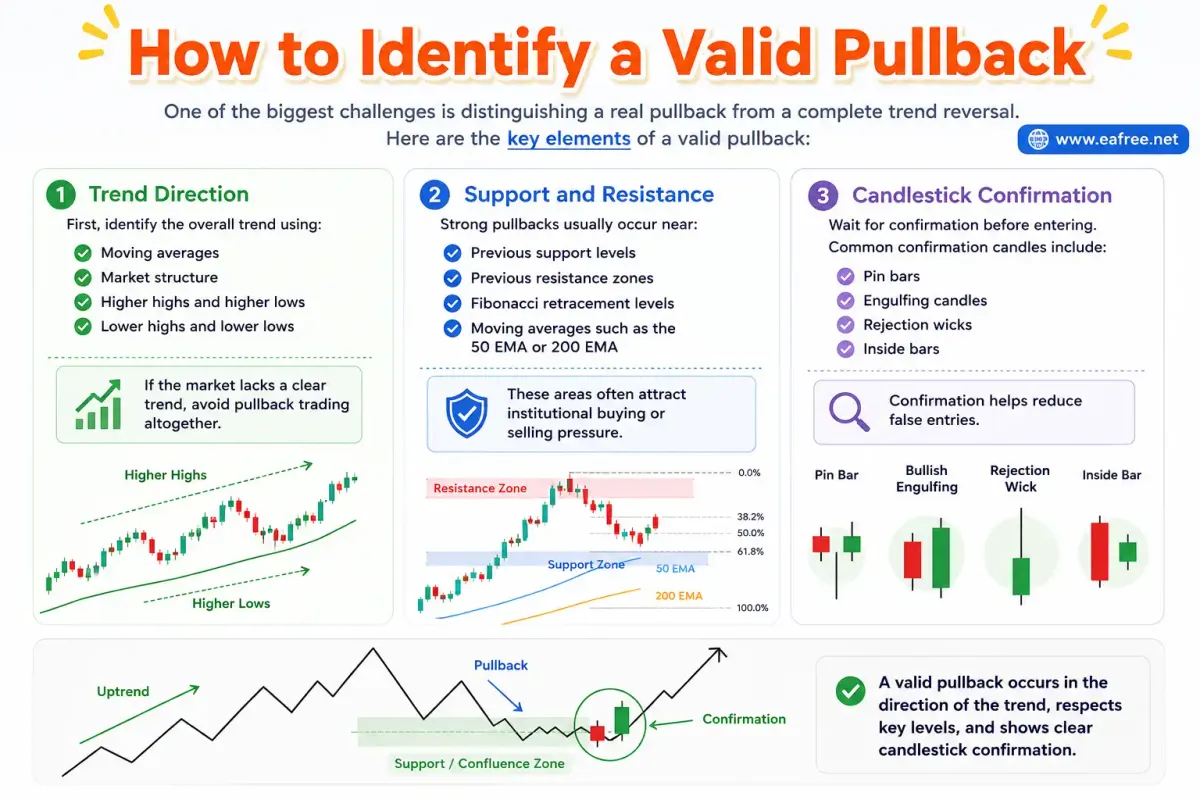
One of the biggest challenges is distinguishing a real pullback from a complete trend reversal.
Here are the key elements of a valid pullback:
//Trend Direction
First, identify the overall trend using:
- Moving averages
- Market structure
- Higher highs and higher lows
- Lower highs and lower lows
If the market lacks a clear trend, avoid pullback trading altogether.
//Support and Resistance
Strong pullbacks usually occur near:
- Previous support levels
- Previous resistance zones
- Fibonacci retracement levels
- Moving averages such as the 50 EMA or 200 EMA
These areas often attract institutional buying or selling pressure.
//Candlestick Confirmation
Wait for confirmation before entering.
Common confirmation candles include:
- Pin bars
- Engulfing candles
- Rejection wicks
- Inside bars
Confirmation helps reduce false entries.
Best Entry Techniques for Pullback Trades
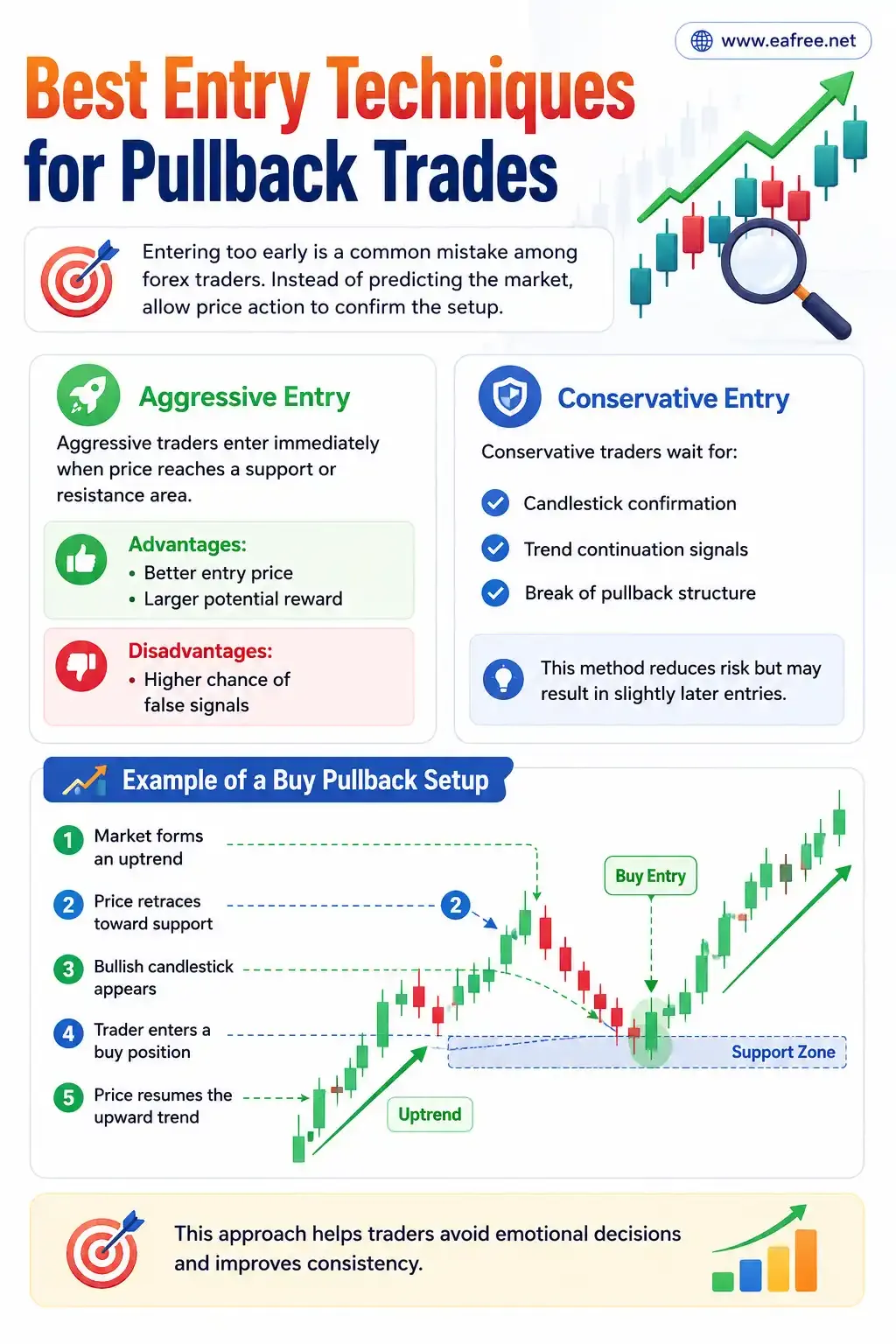
Entering too early is a common mistake among forex traders. Instead of predicting the market, allow price action to confirm the setup.
//Aggressive Entry
Aggressive traders enter immediately when price reaches a support or resistance area.
Advantages:
- Better entry price
- Larger potential reward
Disadvantages:
- Higher chance of false signals
//Conservative Entry
Conservative traders wait for:
- Candlestick confirmation
- Trend continuation signals
- Break of pullback structure
This method reduces risk but may result in slightly later entries.
//Example of a Buy Pullback Setup
- Market forms an uptrend
- Price retraces toward support
- Bullish candlestick appears
- Trader enters a buy position
- Price resumes the upward trend
This approach helps traders avoid emotional decisions and improves consistency.
Exit Strategies for Pullback Trading
Having a proper exit strategy is just as important as finding a good entry.
//Take Profit Targets
Common methods include:
- Previous swing highs or lows
- Fixed risk-to-reward ratios
- Fibonacci extension levels
Many professional traders aim for at least a 1:2 risk-to-reward ratio.
//Trailing Stop Method
A trailing stop allows traders to lock in profits while letting winning trades continue running.
This method works especially well in strong trending markets.
//Partial Profit Taking
Some traders close part of the position early and allow the remaining trade to continue.
Benefits include:
- Reduced emotional pressure
- Locked-in profits
- Opportunity for larger gains
Risk Management Rules Every Trader Should Follow
Even the best forex strategy can fail without proper risk management.
//Risk Only a Small Percentage Per Trade
Most professional traders risk:
- 1% to 2% of account balance per trade
This prevents a losing streak from damaging the trading account.
//Always Use a Stop Loss
A stop loss protects capital and removes emotional decision-making.
For pullback trading:
- Place the stop below support in an uptrend
- Place the stop above resistance in a downtrend
//Avoid Overtrading
Not every pullback is a valid opportunity.
Wait for:
- Clear trends
- Strong confirmation
- Favorable market conditions
Patience is often the difference between profitable and losing traders.
Common Mistakes in Pullback Trading
Many traders fail with pullback strategies because of avoidable mistakes.
//Trading Against the Trend
Counter-trend trading is far riskier and often leads to losses.
Always follow the dominant trend direction.
//Entering Too Early
Trying to predict the exact bottom or top usually results in poor entries.
Wait for confirmation before entering.
//Ignoring Market News
Major economic events can create volatility that invalidates technical setups.
Always check the forex economic calendar before trading.
//Poor Risk Management
Overleveraging and emotional trading can destroy even profitable strategies.
Consistency matters more than fast profits.
Best Indicators for Forex Pullback Strategies
While price action is the most important factor, indicators can help improve decision-making.
| Indicator | Purpose |
|---|---|
| Moving Averages | Identify trend direction |
| Fibonacci Retracement | Locate pullback zones |
| RSI | Detect overbought or oversold conditions |
| MACD | Confirm trend momentum |
Avoid using too many indicators at once. Simplicity often leads to better trading decisions.
Conclusion
The Forex Pullback Strategy is one of the most effective methods for trading trending markets. Instead of chasing price movements, traders patiently wait for retracements and enter at more favorable levels.
Success with this strategy depends on:
- Identifying strong trends
- Waiting for confirmation
- Managing risk carefully
- Staying disciplined
No strategy guarantees 100% winning trades, but consistent execution and proper risk management can significantly improve long-term profitability.
If you are new to forex trading, start by practicing pullback setups on a demo account before risking real capital.
FAQs
❓ What is a pullback in forex trading?
A pullback is a temporary price retracement against the main market trend before the trend continues.
❓ Is pullback trading suitable for beginners?
Yes, pullback trading is beginner-friendly because it focuses on trend-following and structured entry points.
❓ Which timeframe works best for pullback trading?
Many traders prefer the 1-hour, 4-hour, and daily charts because they provide clearer trends and less market noise.
❓ What is the best indicator for pullback trading?
Moving averages and Fibonacci retracement levels are among the most commonly used indicators for identifying pullback opportunities.
❓ How much should I risk per forex trade?
Most professional traders recommend risking only 1% to 2% of your trading account on a single trade.