
Introduction
The Martingale strategy is one of the most controversial yet widely discussed approaches in Forex trading. Originally developed for gambling, this strategy has found its way into financial markets, especially among traders seeking to recover losses quickly. While it may appear simple and even appealing at first glance, the Martingale strategy carries significant risks that every trader must understand before applying it.
In this comprehensive guide, we’ll explore how the Martingale strategy works in Forex, its advantages and disadvantages, and when—if ever—it should be used.
What Is the Martingale Strategy?
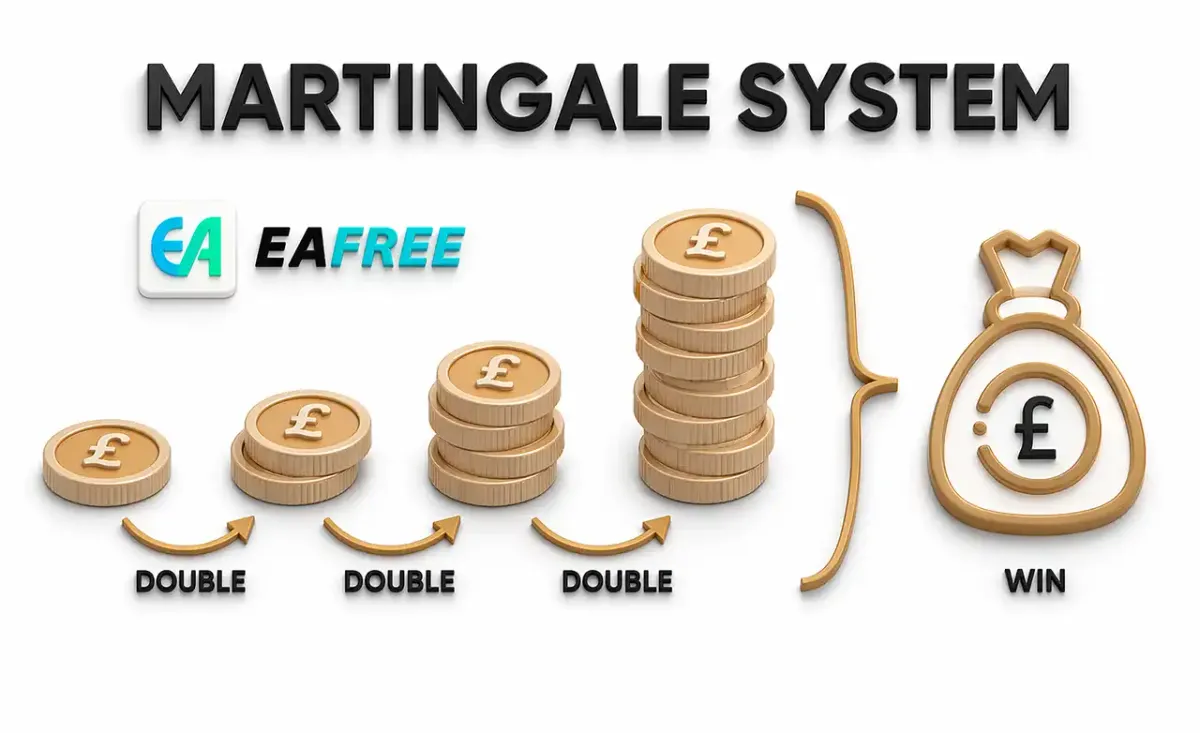
The Martingale strategy is a trading system based on the principle of doubling your position size after every loss. The idea is straightforward:
- If a trade loses, you double your next trade.
- When a winning trade eventually occurs, it recovers all previous losses plus a profit equal to the initial trade size.
//Simple Example
Imagine you start with a $10 trade:
- Trade 1: Lose $10 → next trade = $20
- Trade 2: Lose $20 → next trade = $40
- Trade 3: Lose $40 → next trade = $80
- Trade 4: Win $80 → recover all losses + $10 profit
This system assumes that a winning trade will eventually occur, which is statistically likely—but not guaranteed in the short term.
How the Martingale Strategy Works in Forex
In Forex trading, the Martingale strategy is typically applied in trending or ranging markets using currency pairs.
//Step-by-Step Process
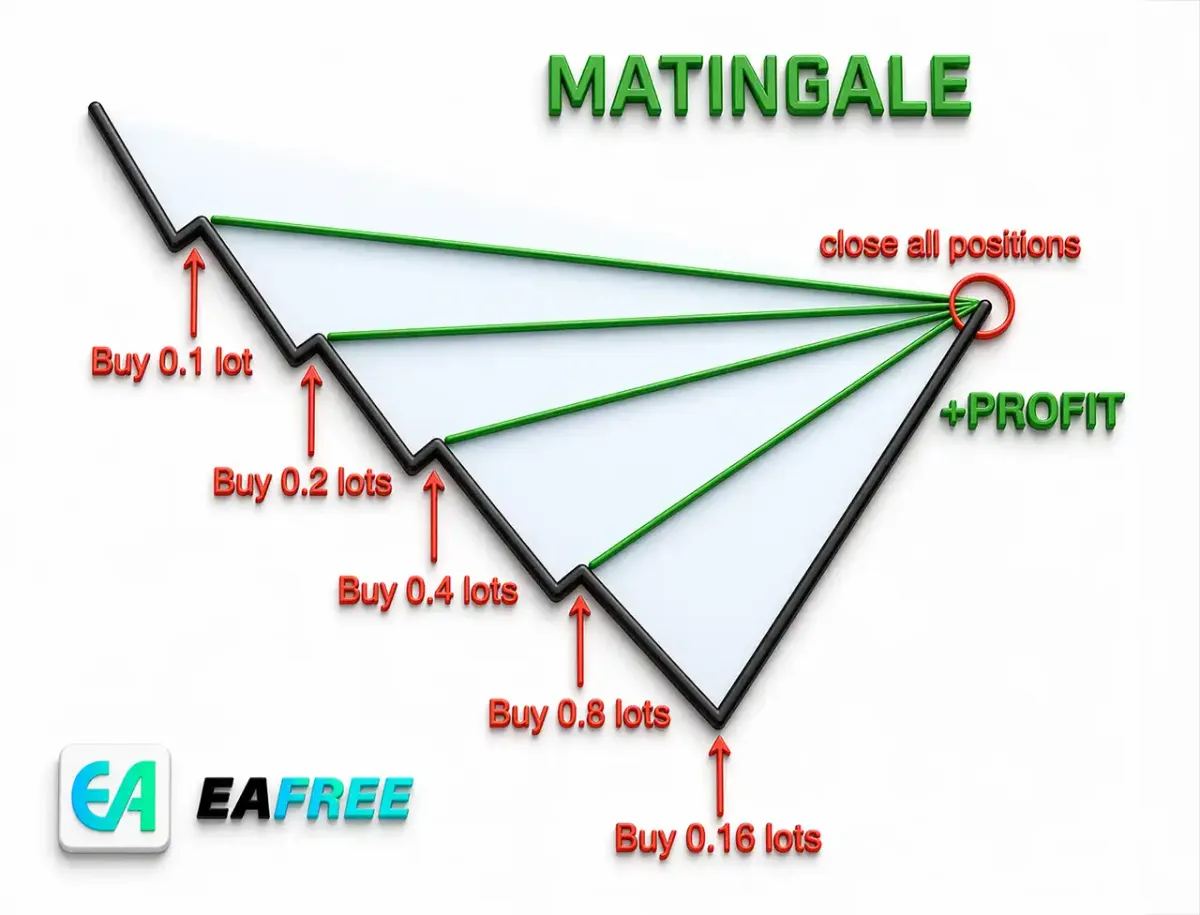
- Open an initial trade (buy or sell) based on your analysis.
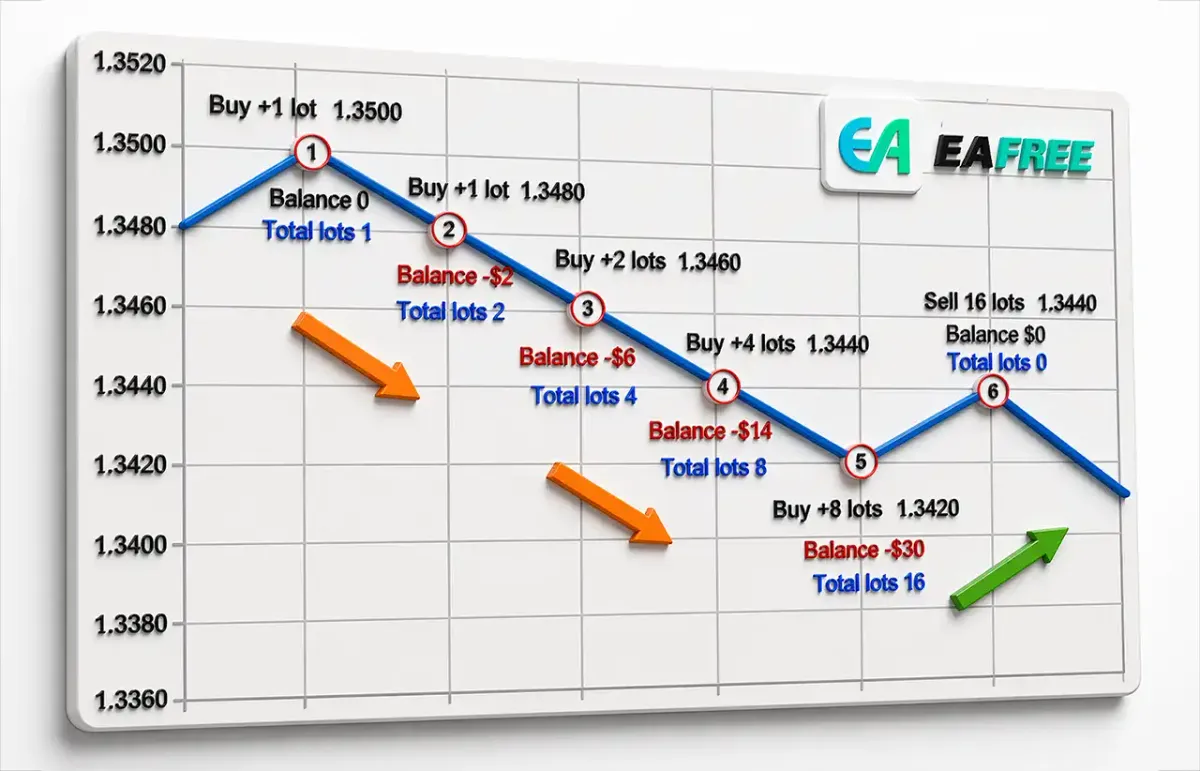
- If the trade loses, open a new trade in the same direction with double the lot size.
- Repeat the process until a winning trade occurs.
- Close all positions once profit is achieved.
//Key Assumptions
- The market will eventually reverse in your favor.
- You have sufficient capital to continue doubling positions.
- Your broker allows large position sizes and margin usage.
Why Traders Are Attracted to Martingale
Despite its risks, many traders are drawn to the Martingale strategy for several reasons:
//1. Simplicity
The system is easy to understand and implement. There’s no need for complex indicators or deep technical analysis.
//2. High Probability of Small Wins
Most Martingale sequences end in a win—at least in the short term—because markets rarely move in one direction indefinitely.
//3. Fast Recovery of Losses
Unlike traditional strategies where losses must be gradually recovered, Martingale aims to recover everything in one trade.
The Major Risks of Martingale
Here’s where things get serious. The Martingale strategy is risky—extremely risky.
//1. Exponential Growth of Risk
Each loss doubles your exposure:
- 1 → 2 → 4 → 8 → 16 → 32 → 64...
It doesn’t take many losing trades before position sizes become dangerously large.
//2. Account Blowout Risk
A prolonged losing streak can wipe out your account. Forex markets can trend strongly for extended periods, making recovery impossible.
//3. Margin Requirements
Forex trading involves leverage, but even with leverage, margin requirements increase rapidly with each doubled position.
//4. Psychological Pressure
Watching your position size grow exponentially while accumulating losses can lead to emotional decision-making.
When Does the Martingale Strategy Work Best?
Although risky, there are specific market conditions where Martingale may perform better.
//1. Ranging Markets
In sideways markets where price oscillates between support and resistance, reversals are frequent—favoring Martingale.
//2. Low Volatility Conditions
Stable price movements reduce the likelihood of extended losing streaks.
//3. Strong Risk Controls in Place
Traders who limit the number of Martingale steps (e.g., max 3–5 trades) reduce catastrophic risk.
When You Should Avoid Martingale
//1. Strong Trending Markets
If the market trends continuously in one direction, Martingale can quickly spiral out of control.
//2. High Impact News Events
Events like interest rate decisions or geopolitical developments can cause large, sustained moves.
//3. Small Trading Accounts
If your capital is limited, you simply cannot sustain multiple doubling trades.
Variations of the Martingale Strategy
Traders often modify the traditional Martingale approach to reduce risk.
//1. Limited Martingale
Set a maximum number of trades (e.g., stop after 4 losses).
//2. Reverse Martingale (Anti-Martingale)
Instead of doubling after losses, you double after wins—capitalizing on winning streaks.
//3. Partial Martingale
Increase position size gradually rather than doubling (e.g., 1.5x instead of 2x).
Risk Management Tips
If you’re considering using Martingale, you need strict risk controls.
//Set a Maximum Loss Limit
Define how much you’re willing to lose before stopping the strategy entirely.
//Use Smaller Initial Lot Sizes
Starting small delays exponential risk growth.
//Combine with Technical Analysis
Don’t rely purely on probability—use support/resistance, trendlines, or indicators.
//Avoid Overleveraging
High leverage accelerates both profits and losses.
Pros and Cons of Martingale in Forex
//Pros
- Easy to understand
- Can recover losses quickly
- High short-term win rate
//Cons
- Extremely high risk
- Requires large capital
- Vulnerable to market trends
- Can lead to total account loss
Is the Martingale Strategy Suitable for Beginners?
In short: No, not really.
While the concept is simple, the risks are complex and often underestimated. Beginners may be tempted by the promise of quick recovery, but without experience in risk management and market behavior, Martingale can be financially damaging.
Realistic Expectations
The biggest misconception about Martingale is that it is a “guaranteed win” strategy. It’s not.
Yes, mathematically, a win will eventually occur—but markets don’t operate in a vacuum. Capital limitations, margin calls, and psychological pressure all come into play.
Final Thoughts
The Martingale strategy in Forex is a double-edged sword. On one side, it offers a seemingly foolproof way to recover losses and generate consistent profits. On the other, it carries the risk of catastrophic losses that can wipe out your trading account.
If you choose to use Martingale, do so with caution:
- Limit your risk
- Use proper analysis
- Never rely on it as your sole strategy
For most traders—especially beginners—there are safer and more sustainable approaches to Forex trading.
FAQs
//1. Is Martingale legal in Forex trading?
Yes, it is legal. However, some brokers may impose restrictions on position sizing or margin.
//2. Can Martingale be profitable long-term?
It’s unlikely. While it may produce short-term gains, long-term sustainability is difficult due to exponential risk.
//3. What’s better than Martingale?
Strategies based on risk-reward ratios, trend following, and proper money management are generally safer.