
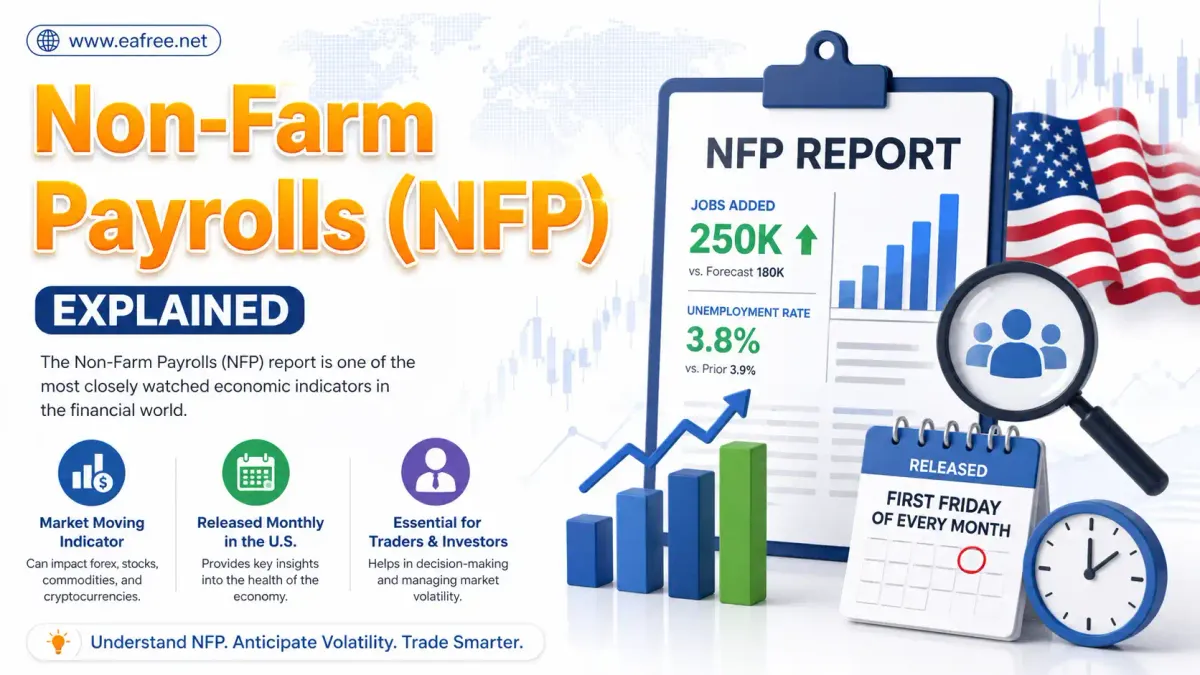
The Non-Farm Payrolls (NFP) report is one of the most closely watched economic indicators in the financial world. Released monthly in the United States, the report has the power to move forex markets, stock indices, commodities and even cryptocurrencies within minutes.
For traders and investors, understanding how NFP works is essential for making informed decisions and managing market volatility. In this guide, we will explain what Non-Farm Payrolls means, why it matters and how traders can use the report effectively.
What Is Non-Farm Payrolls (NFP)?
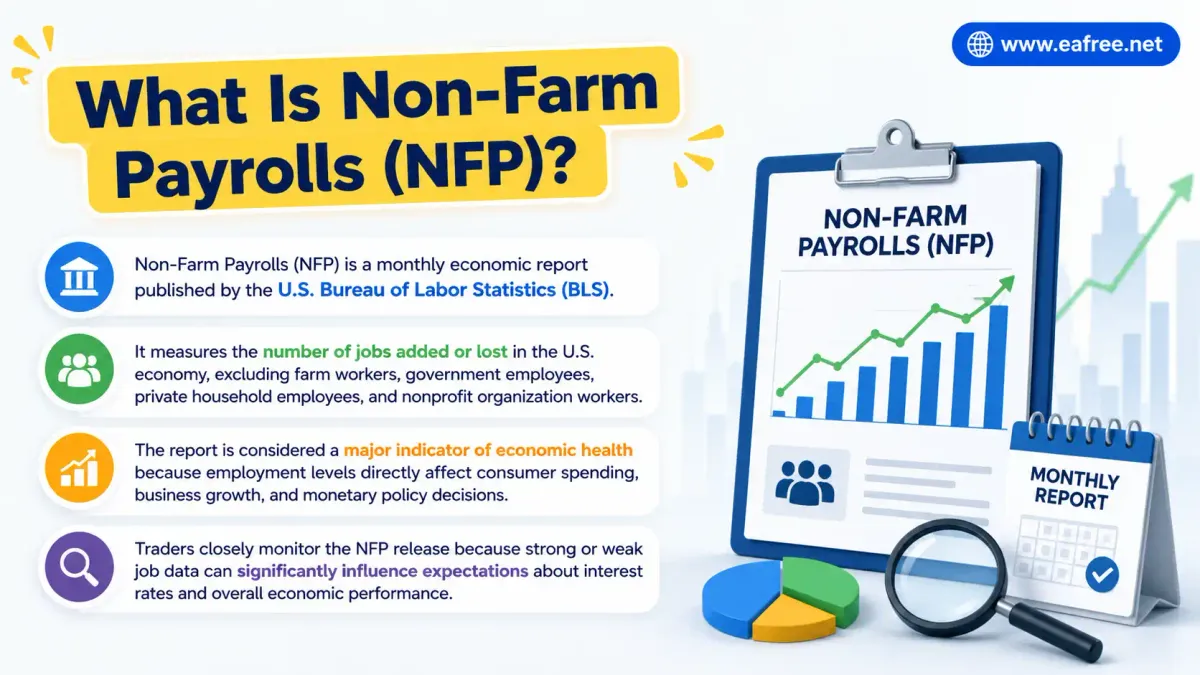
Non-Farm Payrolls (NFP) is a monthly economic report published by the U.S. Bureau of Labor Statistics (BLS). It measures the number of jobs added or lost in the U.S. economy, excluding farm workers, government employees, private household employees, and nonprofit organization workers.
The report is considered a major indicator of economic health because employment levels directly affect consumer spending, business growth, and monetary policy decisions.
Traders closely monitor the NFP release because strong or weak job data can significantly influence expectations about interest rates and overall economic performance.
Why Is the NFP Report Important?
The NFP report provides valuable insight into the strength of the U.S. economy. Since employment is closely linked to consumer confidence and spending, changes in payroll numbers often affect financial markets immediately.
A stronger-than-expected NFP reading generally suggests economic growth, while a weaker report may indicate slowing economic activity.
//Key Reasons Why NFP Matters
| Factor | Impact on Markets |
|---|---|
| Employment Growth | Signals economic strength or weakness |
| Interest Rate Expectations | Influences Federal Reserve decisions |
| U.S. Dollar Movement | Can strengthen or weaken the USD |
| Stock Market Volatility | Affects investor sentiment |
| Gold and Commodities | Impacts safe-haven demand |
Because of its strong market impact, the NFP release often creates high volatility across multiple asset classes.
When Is the NFP Report Released?
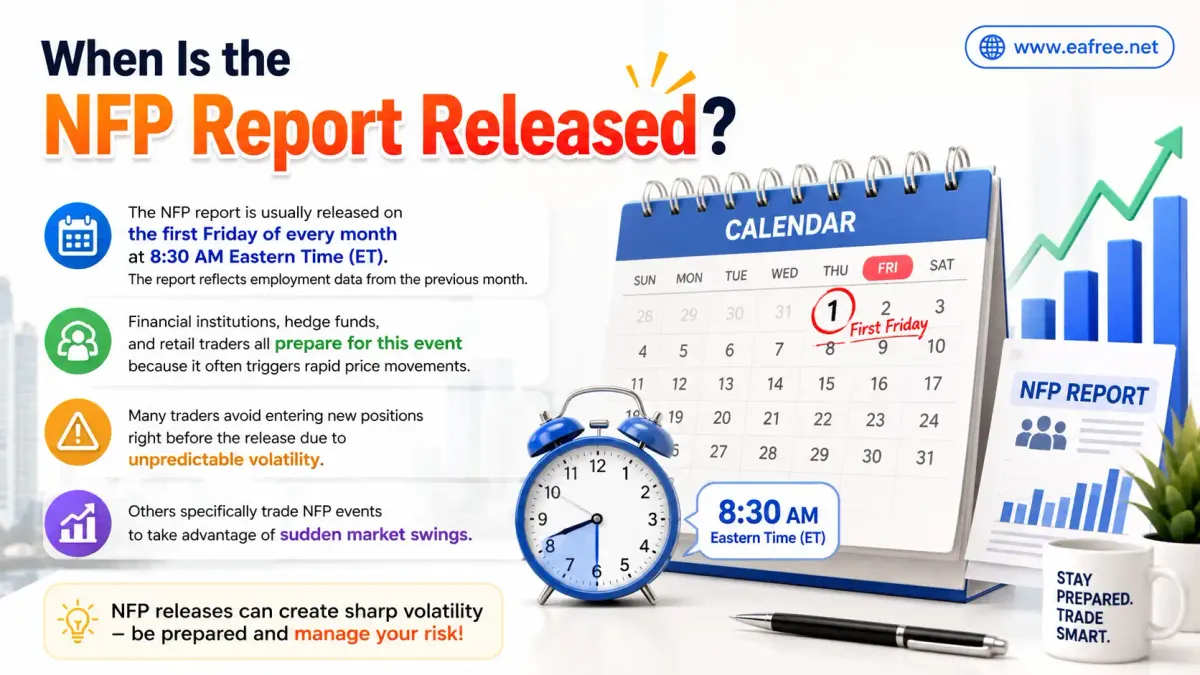
The NFP report is usually released on the first Friday of every month at 8:30 AM Eastern Time (ET). The report reflects employment data from the previous month.
Financial institutions, hedge funds, and retail traders all prepare for this event because it often triggers rapid price movements.
Many traders avoid entering new positions right before the release due to unpredictable volatility. Others specifically trade NFP events to take advantage of sudden market swings.
What Information Does the NFP Report Include?
Although traders often focus on the headline payroll number, the report contains several important data points.
//Main Components of the NFP Report
| Component | Description |
| Non-Farm Employment Change | Number of jobs added or lost |
| Unemployment Rate | Percentage of unemployed workers |
| Average Hourly Earnings | Measures wage inflation |
| Labor Force Participation Rate | Percentage of people actively working or seeking work |
| Revisions to Previous Reports | Updates past employment data |
Among these components, wage growth is especially important because it can signal inflation pressure, which influences Federal Reserve policy.
How NFP Affects Financial Markets
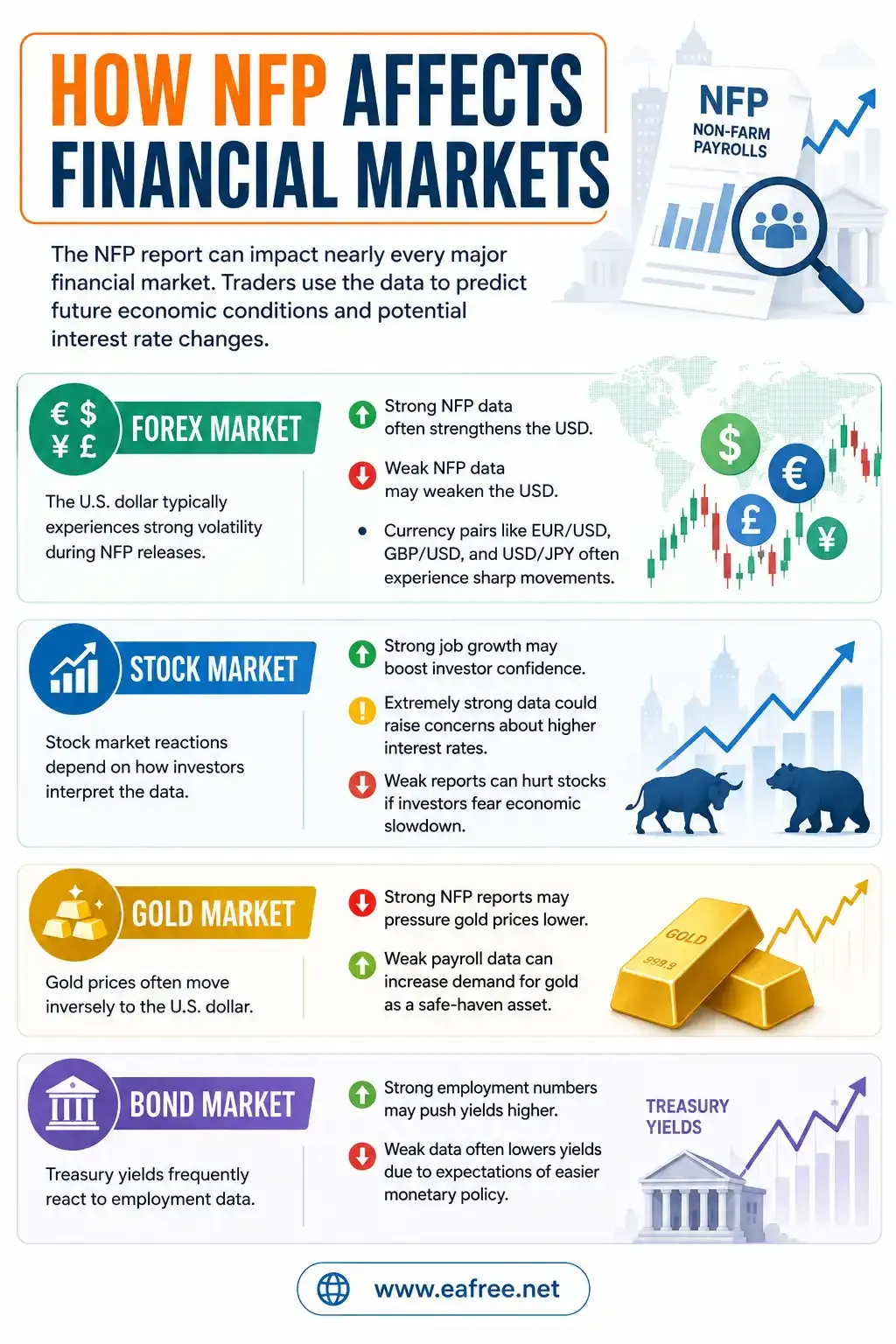
The NFP report can impact nearly every major financial market. Traders use the data to predict future economic conditions and potential interest rate changes.
//Forex Market
The U.S. dollar typically experiences strong volatility during NFP releases.
- Strong NFP data often strengthens the USD.
- Weak NFP data may weaken the USD.
- Currency pairs like EUR/USD, GBP/USD, and USD/JPY often experience sharp movements.
//Stock Market
Stock market reactions depend on how investors interpret the data.
- Strong job growth may boost investor confidence.
- Extremely strong data could raise concerns about higher interest rates.
- Weak reports can hurt stocks if investors fear economic slowdown.
//Gold Market
Gold prices often move inversely to the U.S. dollar.
- Strong NFP reports may pressure gold prices lower.
- Weak payroll data can increase demand for gold as a safe-haven asset.
//Bond Market
Treasury yields frequently react to employment data.
- Strong employment numbers may push yields higher.
- Weak data often lowers yields due to expectations of easier monetary policy.
How Traders Prepare for NFP Releases
Professional traders often develop specific strategies before the NFP announcement.
Preparation is essential because spreads may widen and price movements can become extremely volatile within seconds.
//Common NFP Trading Strategies
| Strategy | Description |
| Breakout Trading | Enter trades after price breaks key levels |
| Straddle Strategy | Place pending buy and sell orders before release |
| Trend Confirmation | Wait for post-news direction confirmation |
| Risk-Off Approach | Avoid trading during extreme volatility |
Risk management is critical during NFP events. Many traders reduce position sizes or use wider stop-loss levels to manage unpredictable market conditions.
The Relationship Between NFP and Federal Reserve Policy
The Federal Reserve closely monitors labor market conditions when making interest rate decisions.
A strong labor market may encourage the Fed to raise interest rates to control inflation. On the other hand, weak employment data may support lower rates or monetary stimulus.
This relationship is one of the main reasons why the NFP report receives global attention from investors and policymakers.
When traders anticipate changes in Fed policy based on NFP results, market volatility can increase dramatically.
Tips for Trading NFP Safely
Trading during major economic events requires discipline and preparation.
Here are several practical tips traders can follow:
- Always check market forecasts before the release.
- Avoid overleveraging positions.
- Use stop-loss orders carefully.
- Wait for confirmation before entering trades.
- Monitor revisions and wage growth data.
- Stay aware of overall market sentiment.
Patience is often more valuable than reacting too quickly during high-impact news events.
Conclusion
The Non-Farm Payrolls (NFP) report remains one of the most influential economic indicators for traders and investors worldwide. Its ability to impact currencies, stocks, gold, and interest rates makes it a critical event in every trader’s calendar.
By understanding how NFP works and how markets typically react, traders can make smarter decisions and improve their risk management strategies.
Whether you trade forex, stocks, or commodities, learning to interpret NFP data can provide valuable insights into market direction and broader economic trends.
FAQs
❓ What does Non-Farm Payrolls mean?
Non-Farm Payrolls refers to the number of jobs added or lost in the U.S. economy, excluding farm workers and several other job categories.
❓ Why does the NFP report affect the forex market?
The NFP report impacts expectations about the U.S. economy and interest rates, which directly influence the value of the U.S. dollar.
❓ Is NFP good for day trading?
Yes, many day traders focus on NFP because of the high volatility and large price movements that often occur after the release.
❓ Which markets are most affected by NFP?
Forex, stock indices, gold, bonds, and commodities are among the markets most influenced by the NFP report.
❓ How can beginners trade NFP safely?
Beginners should use smaller position sizes, avoid excessive leverage, wait for market confirmation, and prioritize risk management over quick profits.