

Forex trading offers exciting opportunities, but it also comes with risks. One of the most important concepts every trader should understand is drawdown. Whether you are a beginner or an experienced trader, knowing how drawdown works can help you protect your trading capital and improve long-term performance.
In this guide, you will learn what drawdown is, how it is calculated, why it matters, and how to reduce it effectively.
What is Drawdown in Forex Trading?
Drawdown in Forex trading refers to the decline in a trading account from its highest value to its lowest point during a specific period. In simple terms, it measures how much money a trader loses before the account recovers and reaches a new high.
For example, if your trading account grows from $1,000 to $1,500 and then falls to $1,200, your drawdown is $300 or 20%.
Drawdown is considered one of the most important risk management metrics because it shows how much risk a trading strategy carries.
Why Drawdown Matters in Forex Trading
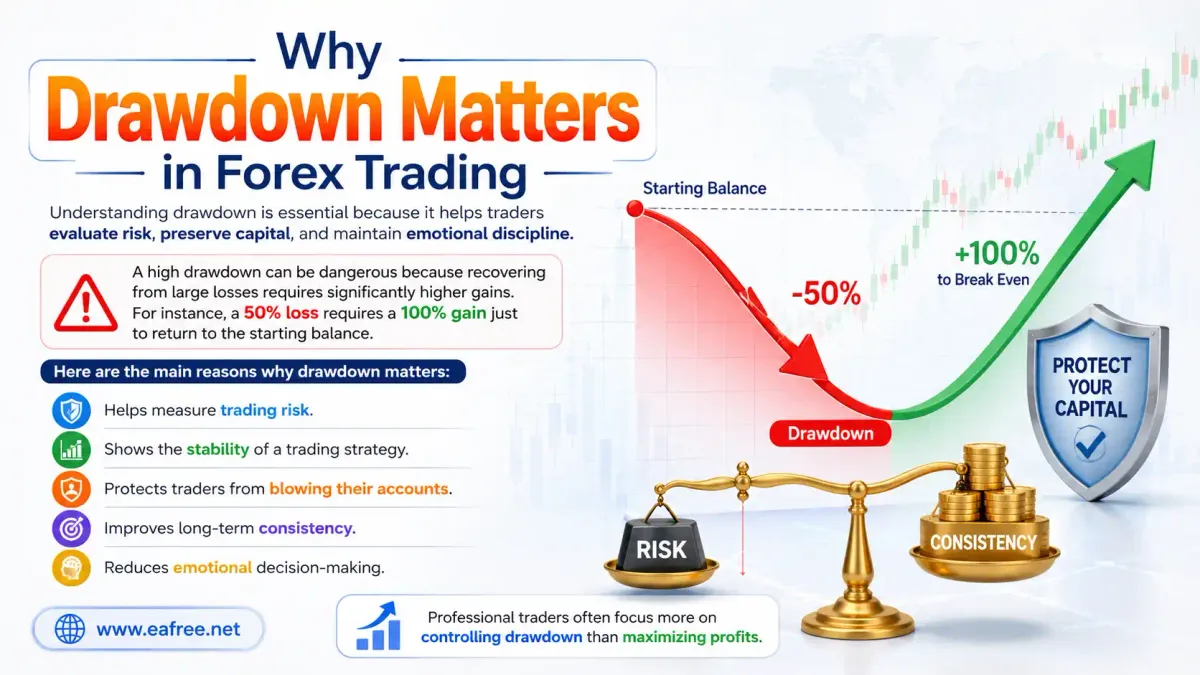
Understanding drawdown is essential because it helps traders evaluate risk, preserve capital, and maintain emotional discipline.
A high drawdown can be dangerous because recovering from large losses requires significantly higher gains. For instance, a 50% loss requires a 100% gain just to return to the starting balance.
Here are the main reasons why drawdown matters:
- Helps measure trading risk.
- Shows the stability of a trading strategy.
- Protects traders from blowing their accounts.
- Improves long-term consistency.
- Reduces emotional decision-making.
Professional traders often focus more on controlling drawdown than maximizing profits.
Types of Drawdown in Forex
There are several types of drawdown that traders should understand.
| Type of Drawdown | Description |
|---|---|
| Absolute Drawdown | Difference between initial deposit and lowest account balance |
| Relative Drawdown | Percentage decline from peak equity |
| Maximum Drawdown | Largest recorded loss from peak to lowest point |
| Equity Drawdown | Based on floating profits and losses in open trades |
Each type provides different insights into account performance and trading risk.
What is a Good Drawdown in Forex?
A “good” drawdown depends on the trader’s strategy and risk tolerance. However, lower drawdown is generally considered safer.
Here is a common guideline:
| Drawdown Level | Risk Level |
|---|---|
| 0% – 10% | Low Risk |
| 10% – 20% | Moderate Risk |
| 20% – 30% | High Risk |
| Above 30% | Very Risky |
Many professional traders aim to keep their maximum drawdown below 20%.
If your drawdown becomes too large, recovering your account can become extremely difficult.
Common Causes of High Drawdown
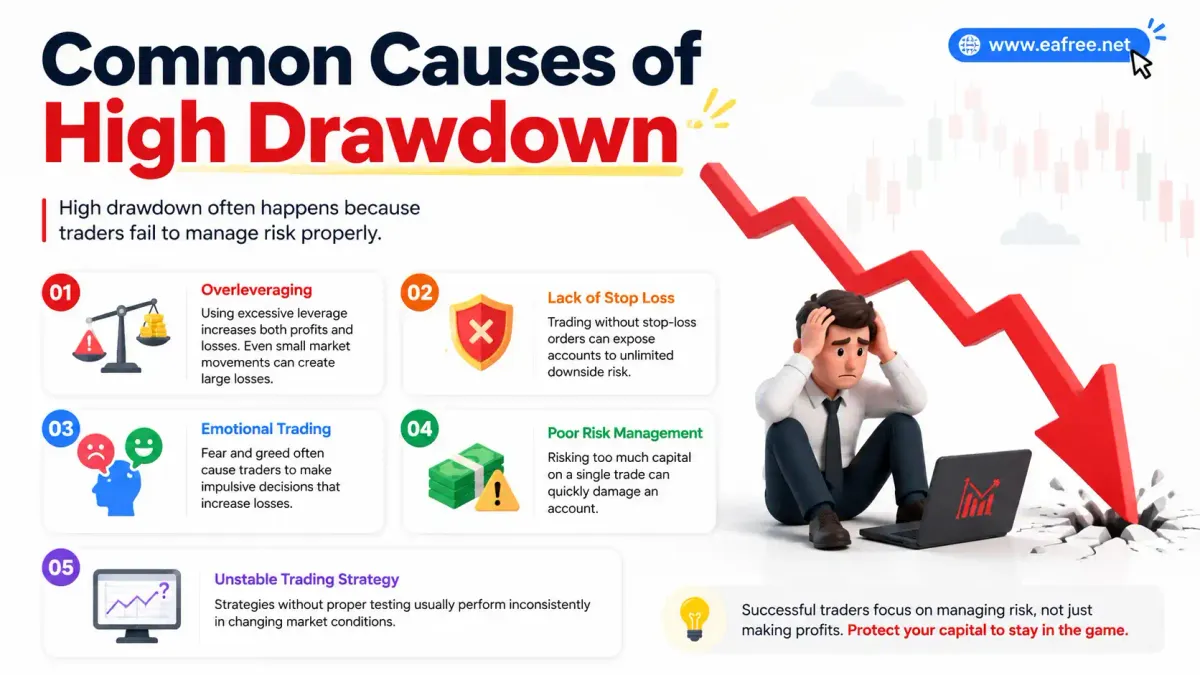
High drawdown often happens because traders fail to manage risk properly.
Some common causes include:
- Overleveraging: Using excessive leverage increases both profits and losses. Even small market movements can create large losses.
- Lack of Stop Loss: Trading without stop-loss orders can expose accounts to unlimited downside risk.
- Emotional Trading: Fear and greed often cause traders to make impulsive decisions that increase losses.
- Poor Risk Management: Risking too much capital on a single trade can quickly damage an account.
- Unstable Trading Strategy: Strategies without proper testing usually perform inconsistently in changing market conditions.
How to Reduce Drawdown in Forex Trading
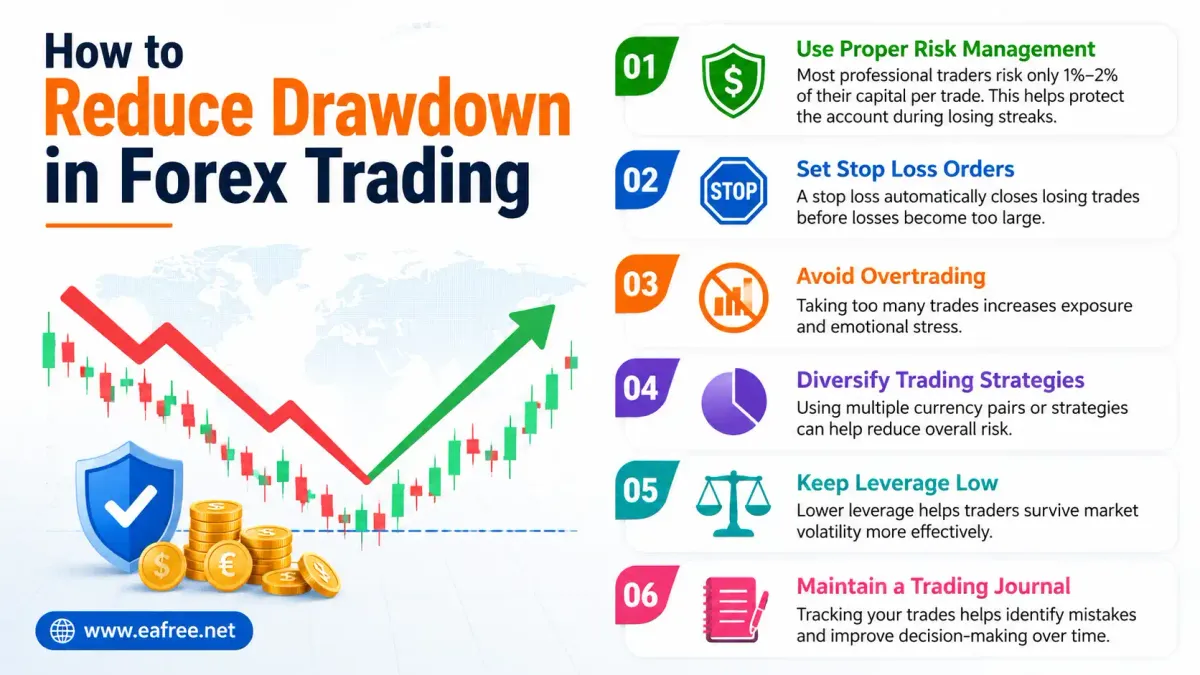
Reducing drawdown should be a priority for every Forex trader. Here are some effective ways to control it.
- Use Proper Risk Management: Most professional traders risk only 1%–2% of their capital per trade. This helps protect the account during losing streaks.
- Set Stop Loss Orders: A stop loss automatically closes losing trades before losses become too large.
- Avoid Overtrading: Taking too many trades increases exposure and emotional stress.
- Diversify Trading Strategies: Using multiple currency pairs or strategies can help reduce overall risk.
- Keep Leverage Low: Lower leverage helps traders survive market volatility more effectively.
- Maintain a Trading Journal: Tracking your trades helps identify mistakes and improve decision-making over time.
Drawdown vs Loss: What’s the Difference?
Many beginners confuse drawdown with regular trading losses, but they are not the same.
| Drawdown | Loss |
|---|---|
| Measures decline from peak balance | Refers to losing money on a trade |
| Focuses on account performance | Focuses on individual trades |
| Usually expressed as percentage | Can be percentage or dollar amount |
| Important for risk management | Part of normal trading |
A trader can experience several small losses without suffering a large drawdown if risk management is controlled properly.
Final Thoughts
Drawdown is one of the most critical concepts in Forex trading. It measures how much your account declines during losing periods and reflects the overall risk of your trading strategy.
Successful traders do not focus only on profits — they focus on controlling losses and protecting capital. By managing risk carefully, using stop losses, and avoiding emotional trading, you can keep drawdown under control and improve your chances of long-term success in the Forex market.
Understanding drawdown is the first step toward becoming a more disciplined and consistent trader.
FAQs
❓ What is the best drawdown percentage in Forex trading?
Most professional traders aim for a drawdown below 10%–20% because it indicates controlled risk.
❓ Can drawdown be avoided completely?
No. Every trader experiences drawdown at some point. The goal is to minimize and manage it effectively.
❓ Why is high drawdown dangerous?
Large drawdowns require bigger profits to recover, making account recovery more difficult.
❓ How can beginners reduce drawdown?
Beginners can reduce drawdown by using stop losses, risking less per trade, and avoiding excessive leverage.
❓ Is drawdown more important than profit?
In many cases, yes. Consistent traders focus on preserving capital first because long-term profitability depends on risk management.