
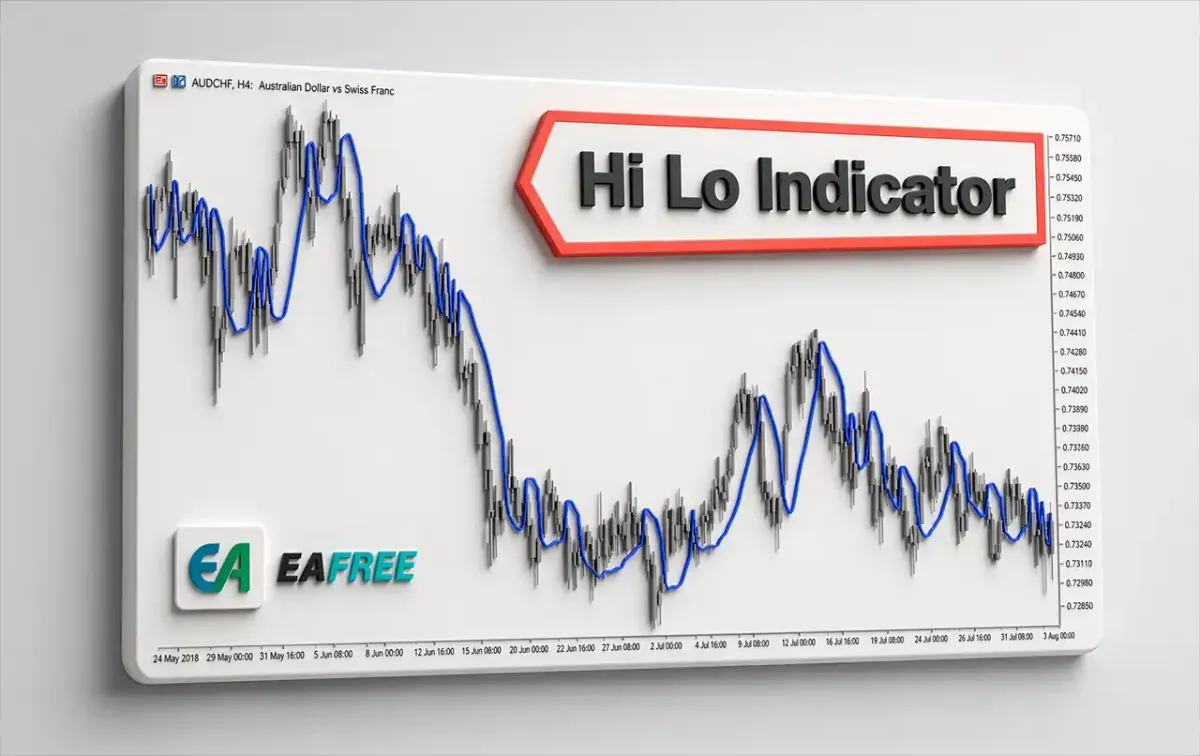
What is the HI-LO Indicator?
The HI-LO Indicator (also known as the High-Low Indicator or Gann Hi-Lo Activator) is a technical analysis tool used to determine market trends based on recent highs and lows.
At its core, the indicator plots a line on the chart that shifts depending on price movement:
- When the market is in an uptrend, the indicator follows recent lows.
- When the market is in a downtrend, it follows recent highs.
This creates a dynamic line that acts as both:
- A trend identifier.
- A potential support/resistance level.
How Does the HI-LO Indicator Work?
The HI-LO Indicator is calculated using a moving average of either highs or lows over a specific period (commonly 3, 5, or 10 candles).
//Basic Logic:
- If price is above the indicator → Bullish trend
- If price is below the indicator → Bearish trend
//Step-by-Step Mechanism:
- Calculate the average of recent highs
- Calculate the average of recent lows
- Plot one of them depending on trend direction:
- Use low average in an uptrend
- Use high average in a downtrend
- Switch when price crosses the line
This switching behavior makes it especially useful for spotting trend reversals.
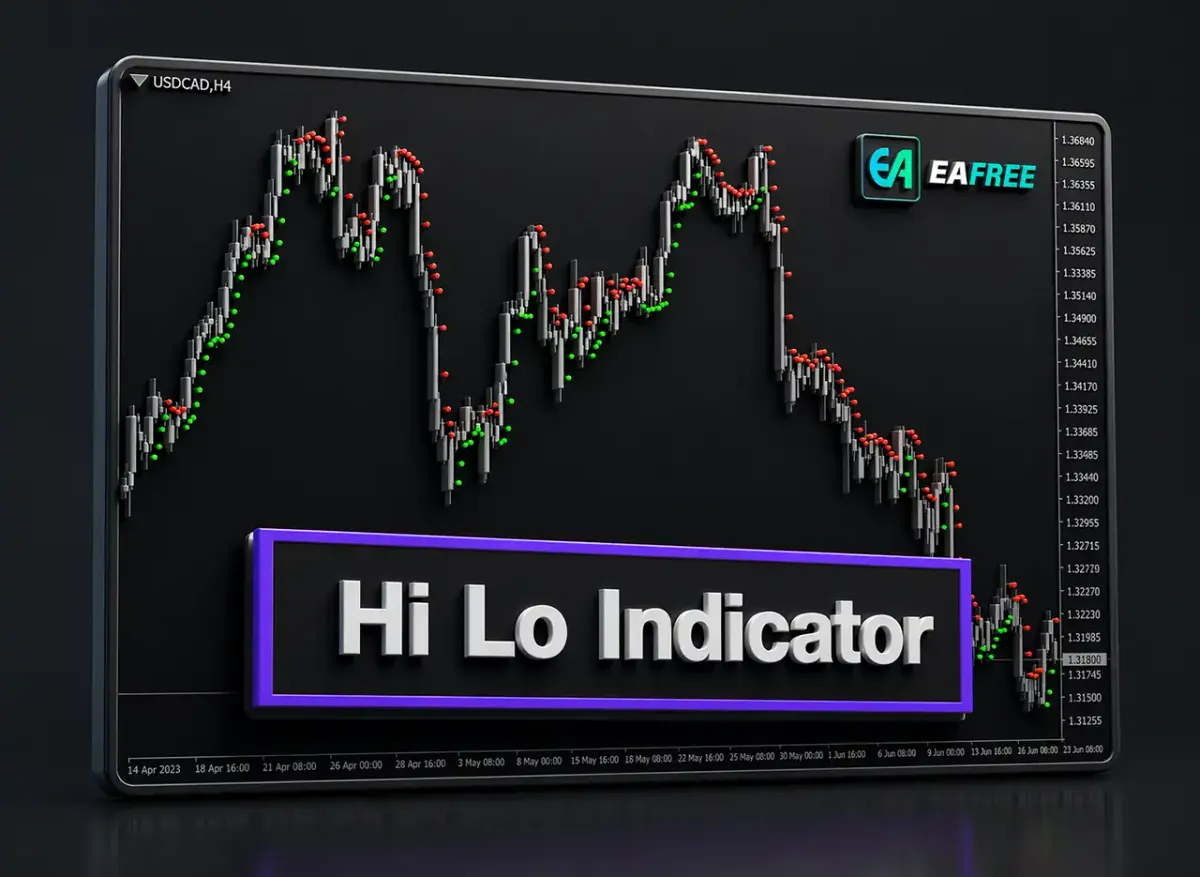
Why Forex Traders Use the HI-LO Indicator
The HI-LO Indicator is popular among Forex traders for several reasons:
//1. Simplicity
It’s easy to understand and apply, even for beginners.
//2. Clear Trend Signals
It provides straightforward buy/sell signals based on price position.
//3. Dynamic Support & Resistance
The indicator line often acts as a trailing support or resistance level.
//4. Reduces Noise
Unlike oscillators, it focuses purely on price movement, avoiding unnecessary complexity.
How to Use the HI-LO Indicator in Forex Trading
Let’s explore practical ways to use this indicator.
//1. Identifying Trends
The most basic use is determining market direction:
- Uptrend: Price stays above the HI-LO line
- Downtrend: Price stays below the HI-LO line
👉 Tip: Trade in the direction of the trend for higher probability setups.
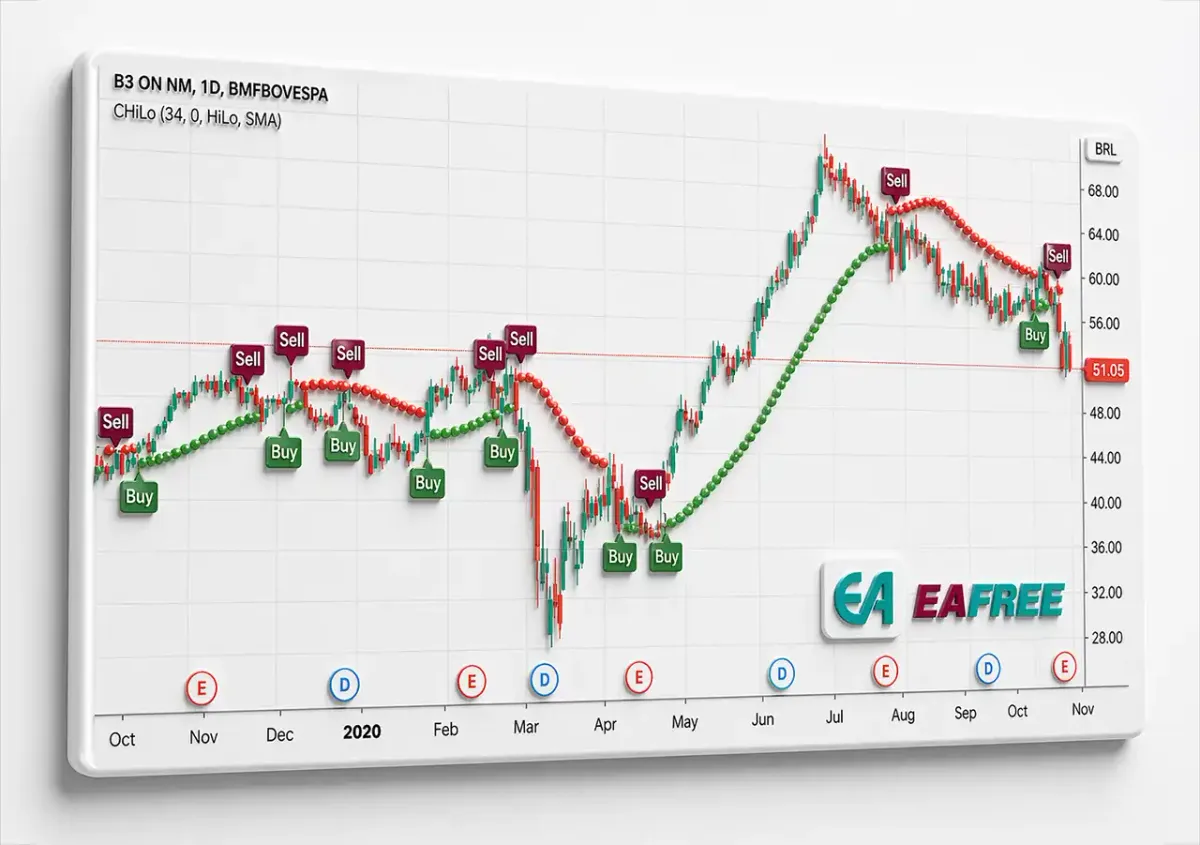
//2. Entry Signals
Buy Signal:
- Price crosses above the HI-LO line
- Indicator flips below price
Sell Signal:
- Price crosses below the HI-LO line
- Indicator flips above price
These signals are especially useful after consolidation phases.
//3. Exit Signals
The HI-LO Indicator also works well as a trailing stop:
- Stay in a trade as long as price remains on the favorable side.
- Exit when price crosses the indicator.
This helps lock in profits while letting trends run.
//4. Combining with Other Indicators
While powerful on its own, the HI-LO Indicator performs even better when combined with other tools:
- Moving Averages
- Confirm long-term trend direction.
- RSI (Relative Strength Index)
- Avoid entering overbought or oversold conditions.
- Support & Resistance Levels
- Improve entry precision.
Best Settings for the HI-LO Indicator
The effectiveness of the HI-LO Indicator depends on your chosen period.
//Common Settings:
- 3-period → More sensitive, faster signals (good for scalping)
- 5-period → Balanced approach (recommended for most traders)
- 10-period → Smoother, fewer signals (better for swing trading)
👉 There’s no “perfect” setting—test different periods based on your trading style.
Example Strategy Using the HI-LO Indicator
Here’s a simple Forex strategy you can try:
//Strategy: Trend-Following with HI-LO
Timeframe: 1H or 4H
Indicator: HI-LO (5-period)
//Rules:
Buy Setup:
- Price crosses above HI-LO line
- Market structure shows higher highs and higher lows
- Enter on pullback
Sell Setup:
- Price crosses below HI-LO line
- Market structure shows lower highs and lower lows
- Enter on retracement
Stop Loss:
- Below recent swing low (buy)
- Above recent swing high (sell)
Take Profit:
- Risk-to-reward ratio of at least 1:2
- Or trail using the HI-LO line
Advantages of the HI-LO Indicator
//✔ Easy to Use
Perfect for beginners and minimalist traders.
//✔ Works in Trending Markets
Helps capture strong directional moves.
//✔ Reduces Emotional Trading
Clear rules reduce guesswork.
//✔ Versatile
Applicable across different timeframes and currency pairs.
Limitations of the HI-LO Indicator
No indicator is perfect, and the HI-LO has its drawbacks:
//✖ Poor Performance in Sideways Markets
Frequent false signals during consolidation.
//✖ Lagging Nature
Based on past price data, so signals may come late.
//✖ Needs Confirmation
Should not be used as a standalone tool in volatile markets.
Tips for Maximizing Effectiveness
To get the most out of the HI-LO Indicator:
- Avoid ranging markets – wait for clear trends
- Use higher timeframes for more reliable signals
- Combine with price action for confirmation
- Backtest your strategy before going live
- Manage risk properly—no indicator guarantees success
HI-LO Indicator vs Other Trend Indicators
| Indicator | Complexity | Signal Speed | Best Use Case |
|---|---|---|---|
| HI-LO Indicator | Low | Medium | Trend following |
| Moving Average | Low | Slow | Long-term trends |
| MACD | Medium | Medium | Momentum + trend |
| Bollinger Bands | Medium | Fast | Volatility trading |
👉 The HI-LO stands out for its balance between simplicity and effectiveness.
Who Should Use the HI-LO Indicator?
This indicator is ideal for:
- Beginner Forex traders
- Price action traders
- Swing traders
- Traders who prefer clean charts
If you dislike cluttered indicators and want something intuitive, the HI-LO is a strong choice.
Final Thoughts
The HI-LO Indicator proves that you don’t need complicated tools to trade effectively. By focusing on recent highs and lows, it delivers clear insights into market trends and helps traders make more confident decisions.
However, like any trading tool, it works best when used as part of a broader strategy. Combine it with solid risk management, market analysis and discipline to unlock its full potential.
If you're looking for a simple yet powerful way to follow trends in the Forex market, the HI-LO Indicator is definitely worth adding to your trading arsenal.
FAQs
//1. Is the HI-LO Indicator suitable for beginners?
Yes, it’s one of the easiest indicators to understand and use.
//2. Can I use it for scalping?
Yes, especially with shorter periods like 3 or 5.
//3. Does it work on all currency pairs?
Generally yes, but it performs best in trending markets.
//4. Is it better than moving averages?
Not necessarily better—just simpler and more responsive in some cases.